The number of solar panels required for agricultural irrigation cannot be determined solely from the kW or HP rating on the pump label. Daily water demand, flow rate, total dynamic head, the pump's actual electricity consumption, the irrigation season and the solar resource at the site must be assessed together. This guide explains which data should be collected to determine the correct capacity and how the calculation results should be interpreted.
Short answer
First, determine the required water volume and the total head over which the water must be moved; then select a suitable pump and drive. The solar array is sized according to the power and voltage range of this equipment and the solar resource during the site's weakest irrigation period. In the final step, divide the required array capacity by the Wp rating of the selected panel and round the result up.
How Does a Solar-Powered Agricultural Irrigation System Work?
The direct current produced by the solar panels is converted into electricity that the pump can use through a solar pump drive or a suitable inverter. The pump carries water from a well, pond or reservoir to the irrigation line or an intermediate storage tank. Irrigation can be performed directly during the day, or a water tank can be filled during sunny hours so that irrigation timing can be managed through storage.
This approach is especially valuable on land where the grid is unavailable or the power infrastructure is inadequate. However, the success of the system does not depend on installing enough panels alone. The pump, drive, solar array, cable cross-section, protection equipment and hydraulic installation must be engineered as an integrated system.
7 Key Inputs That Determine the Number of Panels
1
Daily water demand
Determine the daily water demand in m³/day according to the crop, cultivated area, irrigation method, soil and season.
2
Required flow rate
Dividing daily water demand by the available irrigation period gives the approximate m³/hour that the pump must deliver.
3
Total dynamic head
Static water level alone is not sufficient. Dynamic level, elevation difference, pipe friction losses and the required pressure of the irrigation line must be included.
4
Pump and motor efficiency
Two pumps that deliver the same flow and head may have different electricity requirements. The pump curve and operating point matter as much as the nameplate power.
5
Site solar resource
Irradiance varies by province, district, season, panel orientation, tilt and shading. The design should be based on data for the months when irrigation will take place.
6
Drive operating range
The voltage and current of the solar array must be compatible with the solar pump drive's start-up and MPPT ranges.
7
System losses and site conditions
Panel temperature, cable losses, soiling, equipment efficiency and ageing may reduce actual output. The design margin must be determined for the site; there is no single coefficient that applies to every project.
Step-by-Step Solar Panel Calculation for Agricultural Irrigation
1. Determine water demand and the irrigation window
Begin by finding the land's daily water demand during the peak irrigation period. Then determine how many hours are available to move that water. For example, if demand is 80 m³/day and the available pumping time is 8 hours, the target flow is approximately 10 m³/hour. This is not yet the pump power or number of panels; it is only the starting point for hydraulic design.
2. Calculate total dynamic head
Total dynamic head is the sum of the pumping water level in the well, the elevation of the discharge point, pipe and fitting losses, and the pressure required by the drip or sprinkler irrigation system. Treating the well depth directly as this value may lead to the wrong pump selection.
3. Select the pump according to its operating point
The pump must deliver the target flow at the calculated total dynamic head. Review the manufacturer's pump curve and record the motor's rated power, phase configuration, operating current and voltage. If an existing pump will be used, include its nameplate and curve data rather than relying only on its HP rating.
4. Determine array capacity and electrical compatibility
Calculate the required array capacity by considering the pump's actual input power, drive efficiency and site losses. The panels' series-parallel configuration must then remain within the drive's minimum start-up voltage, MPPT range, maximum DC voltage and current limits. Sufficient total wattage alone does not guarantee that the system will operate.
5. Calculate the number of panels
Number of panels = Required solar array capacity (Wp) / Selected panel power (Wp)
If the result is not a whole number, round it up. For example, if the engineering calculation requires an 8,000 Wp array and 600 Wp panels are selected, 8,000 / 600 = 13.33; at least 14 panels are considered. This example illustrates the arithmetic only. The final number and array configuration are confirmed after the panels' Voc/Vmp values, temperature corrections and drive limits have been verified.
Important: Fixed answers such as “this exact number of panels is required for a 5.5 kW pump” can be misleading. The same motor produces different results under different well levels, flow rates, pipework and solar conditions.
Which System Architecture Is Suitable?
| System |
Suitable use |
Points to consider |
| Direct solar pumping |
Sites where irrigation can take place during the day or water can be pumped into storage |
Flow may change with irradiance during the day; drive and array compatibility is critical. |
| Water storage system |
Operations that pump water during sunny hours and irrigate when required |
Tank volume, elevation and irrigation pressure must be calculated correctly. In some projects, storing energy as water may be simpler than storing it in a battery. |
| Hybrid system |
Sites where interruptions cannot be tolerated and grid or generator support is available |
Source switching, protection arrangements and operating scenarios must be clearly defined in the design. |
| Battery-based system |
Special applications where night-time pumping is essential or small auxiliary loads must also be supplied |
Battery capacity, cycle life, temperature and replacement cost must be included in the overall investment calculation. |
Information Required for an Accurate Site Survey
- Exact location or coordinates of the land
- Crop pattern, cultivated area and irrigation months
- Daily or seasonal water demand
- Static and dynamic water level of the well
- Elevation difference between the water outlet and the land
- Pipe diameter, length and equipment along the line
- Pressure required for drip or sprinkler irrigation
- Pump nameplate and pump curve, if available
- Availability of grid power or a generator
- Unshaded area and ground information for panel placement
The PVGIS tool provided by the European Commission's Joint Research Centre can be used to assess location-specific solar irradiance and monthly PV yield potential. PVGIS provides a preliminary assessment; it does not replace well, pump and electrical system design.
CW Enerji Agricultural Irrigation Solutions
CW Enerji's verified agricultural irrigation packages offer options for pump ratings ranging from 0.75 kW to 110 kW. Package selection should be based on site measurements and operating requirements as well as pump power.
The 645 Wp AgriFlow agricultural irrigation panel is designed to contribute to fewer connections and a simpler system design through its high operating voltage, low-current structure and irrigation-specific cell architecture. The number of panels and array layout are still determined according to the pump drive's electrical limits and site analysis.
CW Enerji addresses site survey, engineering, product selection, installation and technical support as an integrated process. Remote monitoring and management options for solar irrigation systems can also help operators track the system without travelling to the site.
How Should the Current Status of Grants and Support Be Checked?
Solar irrigation investments were included in the 21st-stage programme conducted by the Turkish Ministry of Agriculture and Forestry under Communiqué No. 2026/10. As of September 2026, some provincial directorates have published the evaluation results for 2026 applications. Previous application rates or dates should therefore not be assumed to apply to a new call.
When planning support for a new period, always verify the current communiqué, implementation guide, eligible expenditure items, technical documentation requirements and application calendar with the Ministry of Agriculture and Forestry and the relevant provincial or district directorate. Product or system selection should not be based solely on documents from an earlier period before the new support conditions have been confirmed.
Common Mistakes
- Selecting a package using only the HP rating: Hydraulic demand and drive compatibility may be overlooked.
- Treating well depth as total dynamic head: Dynamic water level, elevation, line losses and pressure demand are omitted.
- Expecting the same flow in summer and winter from an annual average solar value: The monthly generation profile during irrigation months is ignored.
- Considering only total panel wattage: The drive's voltage, current or MPPT limits may be exceeded, or the start-up voltage may not be reached.
- Ignoring shade and temperature: Partial shading and high panel temperature in particular can reduce actual field performance.
- Omitting the protection and maintenance plan: DC/AC protection, earthing, lightning protection, cable routing and periodic inspection are part of safe operation.
Let Us Determine the Right Number of Panels for Your Land
A site survey based on the pump nameplate, well data, daily water demand and land location turns the panel count from an estimate into an engineering calculation. Explore CW Enerji's irrigation solutions and contact the expert team for a system design tailored to your project.
Request a free site survey and quote
Frequently Asked Questions
How many solar panels are required for a 5.5 kW irrigation pump?
There is no single correct number. The pump's operating current and voltage, total dynamic head, target flow, irrigation duration, location and the selected panel's Wp/Voc/Vmp values must be known. Once the required array capacity has been calculated, the number of panels is determined and drive compatibility is verified.
Can a solar irrigation system operate without batteries?
Yes. Many systems that pump directly during the day or store water in a tank can be designed without batteries. If night-time irrigation is essential, water storage, a grid/generator-supported hybrid configuration or a battery solution suited to the project can be considered.
Can solar-powered irrigation work in cloudy weather?
Panels also generate electricity from diffuse irradiance, but output may decrease and the pump's flow may fall. The drive's operating threshold, array design, water storage and any hybrid support determine how these conditions are managed.
Can the number of panels be selected according to the pump's HP rating?
The HP rating is only one of the initial inputs. Correct selection requires the pump operating point, motor efficiency, electrical values, drive range and site solar resource to be assessed together.
Are grants available for solar-powered irrigation systems?
Support programmes open periodically and their conditions may change. The programme under Communiqué No. 2026/10 included solar irrigation investments; as of September 2026, results for the 21st stage are being announced. Current calls and calendars for new applications must be checked through the Ministry's official channels.
Sources
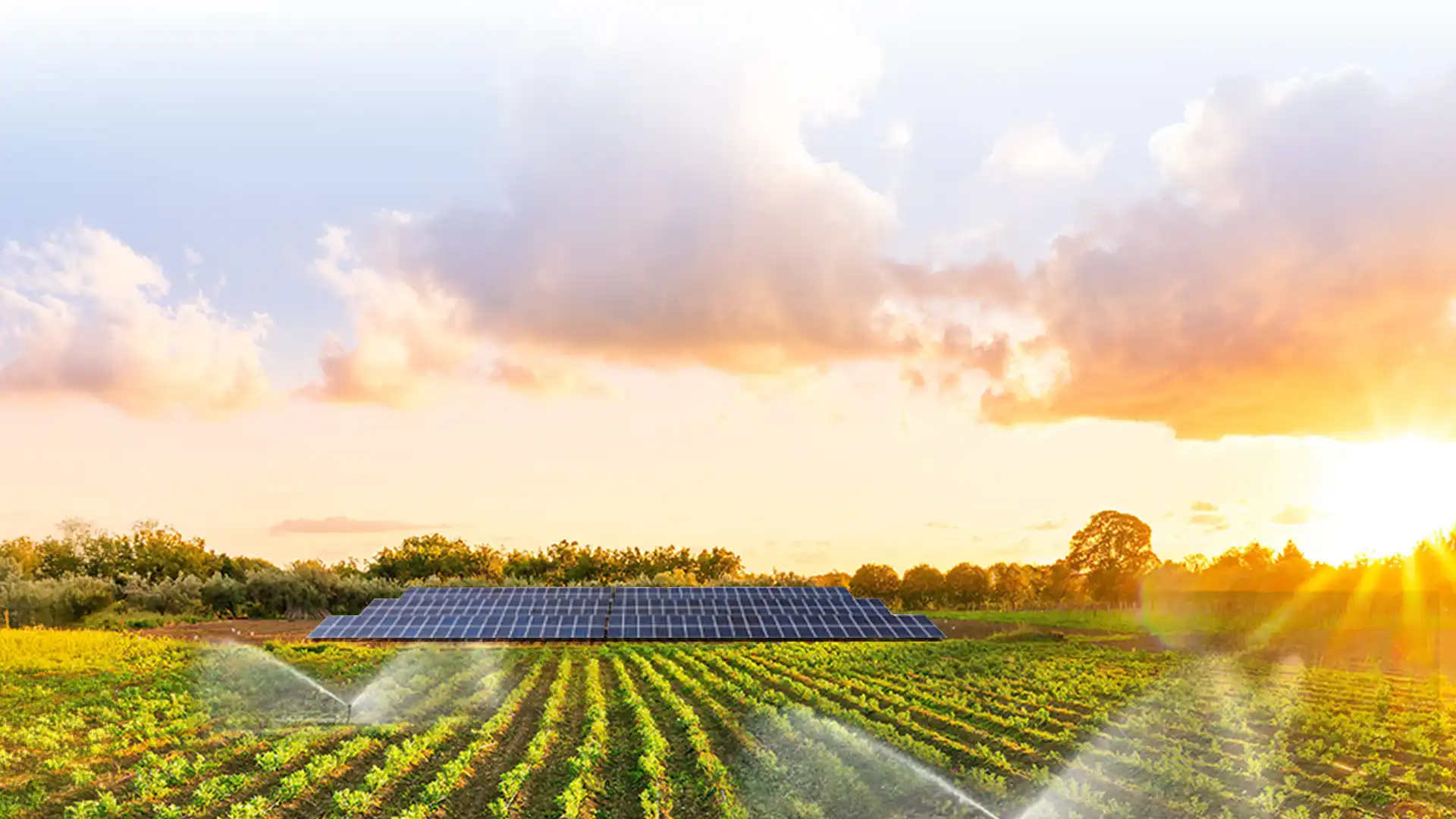 A New Era in Irrigation with AgriFlow Technology
Developed with CW Enerji’s engineering expertise, AgriFlow technology provides high operating voltage from a single panel, enabling fewer connections, simpler installation, and more efficient irrigation throughout the day.
Detailed Review
A New Era in Irrigation with AgriFlow Technology
Developed with CW Enerji’s engineering expertise, AgriFlow technology provides high operating voltage from a single panel, enabling fewer connections, simpler installation, and more efficient irrigation throughout the day.
Detailed Review
 Solar Panels
  Inverters
  CHARGE CONTROLLERS
  SOLAR PACKS
  Solar Equipment
  ENERGY STORAGE SOLUTIONS
  HEATING, COOLING AND HOT WATER
  ELECTRIC VEHICLE CHARGERS
  Solar Lighting Solutions